
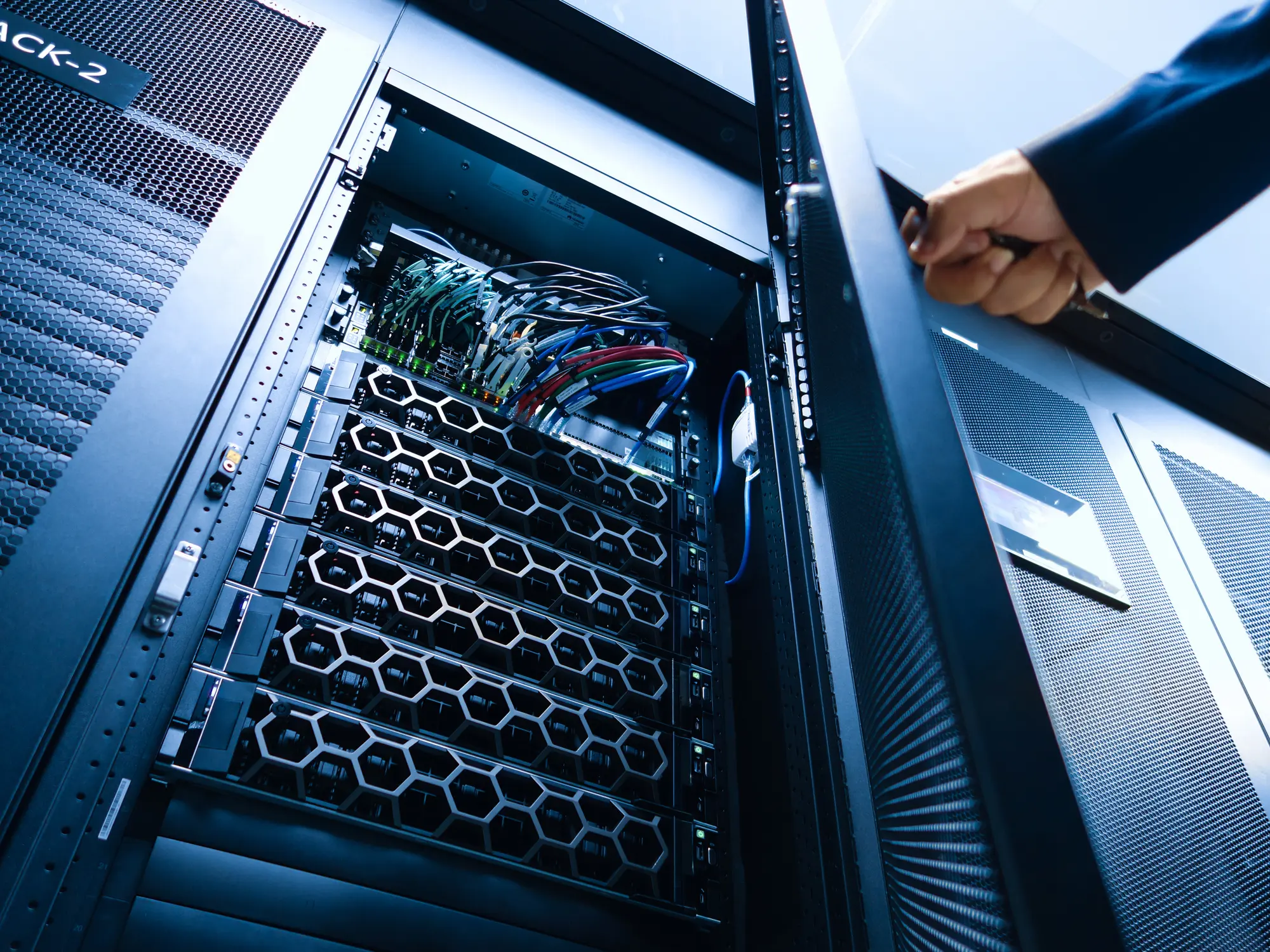
To reliably operate around the clock, data center servers depend on carefully engineered infrastructure that protects sensitive equipment and controls airflow. This infrastructure includes precision-fabricated server racks, cabinets, enclosures, and components designed to meet the dimensional requirements and critical demands of hyperscale facilities.
Vander-Bend has spent more than forty-five years building the physical infrastructure that data centers and other demanding industries depend on. Our advanced sheet metal fabrication capabilities and unwavering quality standards ensure that assemblies meet exact specifications. This guide examines the core categories of data center infrastructure and the intrinsic value of partnering with an experienced manufacturer.
Read on to discover our expert insights and contact us to inquire about solutions for your application.
Data Center Racks and Cabinets
Equipment racks house servers, networking switches, and power systems in an open-frame layout that gives technicians easy access for installation and maintenance. This accessibility requires standardized precision fabrication at scale.
Rack sizing is measured in rack units (U), where 1U equals 1.75 inches of vertical space. For example, a single server might occupy 1U, but larger switching and storage hardware often span several units. Full-height configurations commonly measure 42U or 45U. Half-height racks and cabinets are better suited for edge deployments or sites with limited space, whereas open two-post frames are often used for lighter networking loads when a fully enclosed footprint is not required.
Cabinets and Enclosures
For equipment that requires more protection than an open-frame format offers, cabinets and enclosures work best. Fully paneled and lockable cabinets safeguard sensitive hardware from dust and moisture as well as unauthorized access.
EMI and RFI shielding are another reason enclosed cabinets are frequently used in data centers. Densely packed electronics generate electromagnetic interference that can impede signals to nearby components or violate regulatory emission limits. Precision-engineered cabinets block interference without compromising airflow through conductive gasketing, covered vents, and grounded panel seams.
Smaller Parts Behind Data Center Infrastructure
While large infrastructure assemblies like racks and cabinets are often a key focus for data centers, many smaller components also play a major role in supporting daily operations, including:
- Mounting brackets: Provide a stable connection point for securing equipment, rails, and accessories to the frame
- Shelves and trays: Support non-rack-mountable equipment and keep items organized inside a rack or cabinet
- Cable management components: Organize power and data cables to ensure proper airflow and serviceability
- Panels and covers: Seal unused rack space and direct airflow where cooling is needed most
- Doors and access panels: Control physical access while still allowing proper ventilation
- Mounting rails: Provide standardized attachment points that allow equipment to slide into place and lock securely
- Chassis and subassemblies: Safely house internal electronics and structural elements inside a larger enclosure
- Gussets, reinforcement components, and structural stiffeners: Add rigidity to frames and enclosures that carry significant static or heavy loads
- Custom hardware and brackets: A solution for unique, application-specific mounting or integration challenges
Who Fabricates Data Center Physical Infrastructure Matters
Tight tolerances are essential to creating data center infrastructure. It can be the difference between components that protect critical systems and assemblies that struggle to meet the demands of continuous operation.
A bracket that is a millimeter off the required dimensions can prevent proper seating, strain fasteners, and create gaps that compromise EMI shielding. This can lead to costly rework and disrupted data center workflows.
Partnering with a renowned sheet metal fabricator like Vander-Bend, with decades of experience, reduces these risks significantly. From careful material selection to robust quality inspections, consistency and precision are built into every part of the production process.
Choose Vander-Bend for Data Center Infrastructure Fabrication
Data center infrastructure is a broad term that encompasses a wide range of parts and assemblies, including racks, cabinets, mounting hardware, and cable management components. Every part needs to perform reliably under the demanding conditions of high-density facilities.
Many data center suppliers partner with Vander-Bend because of our extensive sheet metal fabrication capabilities and decades of experience. Our team collaborates closely with clients starting at the design phase and continuing through production, with quality control measures in place to protect precision and delivery schedules. Contact us today to discuss your project needs.