
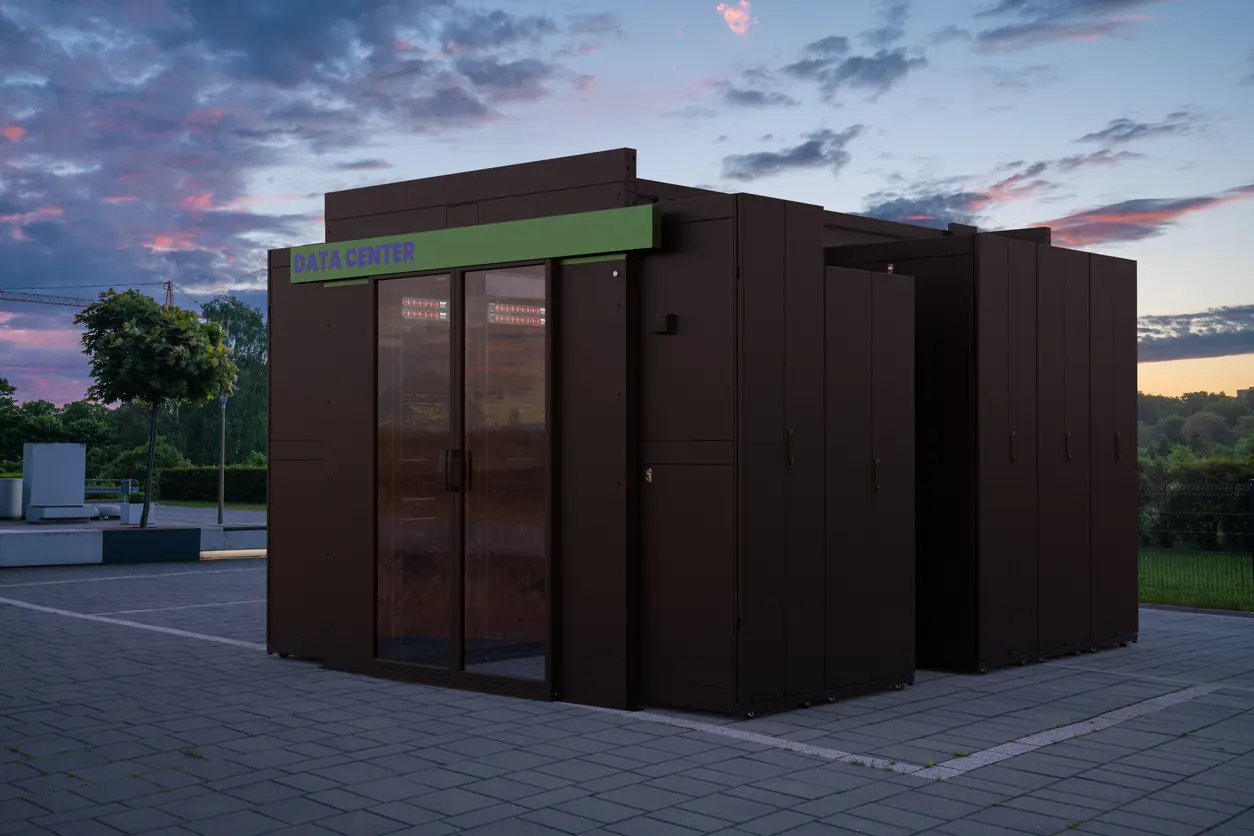
The need for data center capacity is now outpacing construction capacity. AI training clusters and interference workloads require power densities that legacy facilities often struggle to support, and operators need new capacity in months rather than years. Prefabricated modular data centers address this by shifting most construction to a controlled factory environment, allowing production and site preparation to proceed simultaneously.
Metal fabrication is at the heart of this conversation. Each module relies on a structural skeleton and a protective enclosure as well as hundreds of precision-made parts that must fit together seamlessly. Vander-Bend’s guide below examines the engineering behind these metal components and why it’s central to scalable modular infrastructure. Reach out to discover more and learn how our capabilities support data center suppliers with components engineered for consistency at volume.
What Is a Prefabricated Modular Data Center?
A prefabricated modular data center is a facility built out of standardized, factory-assembled units that are delivered on site ready for connection. A unit is engineered as a repeatable product, not a one-off construction project. Site crews place and connect the modules instead of constructing rooms piece by piece.
Modules commonly fall into three categories:
- IT modules house the server racks and the white space where computing equipment operates.
- Power modules contain the switchgear and uninterruptible power supply (UPS) systems as well as the distribution equipment that delivers electricity to the IT load.
- Cooling modules carry chillers or air handling units and increasingly include coolant distribution units for liquid cooling.
The key advantage of prefabricated modular data centers is concurrency. Building shells must be complete prior to fit-out with traditional construction projects, but with modules, the factory manufactures and integrates modules as the site team pours the foundation and connects utilities.
Critical Metal Components of Modular Infrastructure
Structural metalwork is as integral to prefabricated modular data centers as the high-capacity power systems they enclose. The following fabricated components are found in nearly every module.
Structural Frames and Skids
The base frame supports the module during lifting, transport, and throughout its service life. Engineers typically specify welded structural steel members sized for static equipment loads and dynamic shipping loads. A fully populated IT module can weigh tens of thousands of pounds, so lifting lug and forklift pocket designs must account for its center of gravity.
Enclosure Panels and Doors
Enclosure panels in prefabricated modular data centers are typically fabricated from galvanized or coated steel with insulated assemblies that guard equipment against weather and physical intrusion. At door openings, that protection depends on consistent bend geometry in the frames and gasket seams for uniform seal compression around the full perimeter.
Server Racks and Cabinets
Racks are among the most common metal components in prefabricated module data centers. They often conform to EIA-310 for 19-inch equipment mounting, with static load ratings now typically meeting or exceeding 3,000 pounds to support dense GPU servers.
Higher equipment density also increases heat output, requiring perforated cabinet doors with a high open area for adequate airflow. Beyond thermal performance, precision fabrication keeps cabinet frames square for accurate rail and accessory installation.
Containment Systems
Hot aisle and cold aisle containment separates supply air and exhaust air to ensure cooling efficiency. Effective containment requires metal roof panels and end-of-row doors mounted to framing that aligns with rack rows within tight tolerances. Even small gaps can lead to bypass airflow and wasted cooling energy.
Cable Management and Busway Support
Overheard cable trays and ladder racks route power and fiber cables throughout prefabricated modular data centers. Busway systems are used to deliver power to rack positions and rely on rigid support brackets with precise hanger spacing. These parts are vital as they affect how quickly field crews can complete final connections.
Equipment Housings and Brackets
Coolant and power distribution units often require custom housing, as do battery systems. Many of these assemblies use laser-cut sheet metal with machined mounting features and integrated wire harnesses.
Engineering for Repeatability and Scale
Adding capacity module by module is only feasible when each unit is dimensionally identical to the previous one. That level of consistency stems from disciplined process control during fabrication.
- Tolerance control: Early tolerance stack-up analysis accounts for variation across module interfaces. Fiber laser cutting and CNC press brakes then hold that precision throughout production.
- Datum-driven design: Shared datums and GD&T keep all parts measured against the same reference features.
- Standardized interfaces: Stable connection points allow internal equipment to evolve without redesigning the frame or enclosure.
- Fixtured welding: Dedicated features control part location and heat distortion for repeatable welds at scale.
Factory Integration, Testing, and Transport
Prefabricated modular data centers must withstand vibration and shock loads during transport to the site. Engineers typically prepare modules for these loads by adding temporary bracing and carefully inspecting welds at lifting points.
Preparing a module for shipment also involves verifying system performance. Factory acceptance testing (FAT) confirms power and cooling system operation before the module leaves the plant. Fit issues are corrected on the factory floor rather than in the field. Performing this work indoors eliminates weather delays and makes project schedules more predictable.
Choose Vander-Bend for Prefabricated Modular Data Center Components
Prefabricated modular data centers have gained popularity for their speed and scalability. These innovative pieces of infrastructure are comprised of precision fabricated components that work together to support daily operations. Frames must carry heavy load. Enclosures must be properly sealed. Racks and containment must align, and every module must mirror the one before it.
If your team is investing in modular deployment or refining an existing platform, consult with Vander-Bend. Our capabilities range from automated sheet metal manufacturing to large format machining along with electromechanical assembly. We’ve also worked with countless data center suppliers to drive their projects forward. Give us a call today.